What Did Putin Mean by a ‘Civilized Divorce’ between Armenia and Russia?
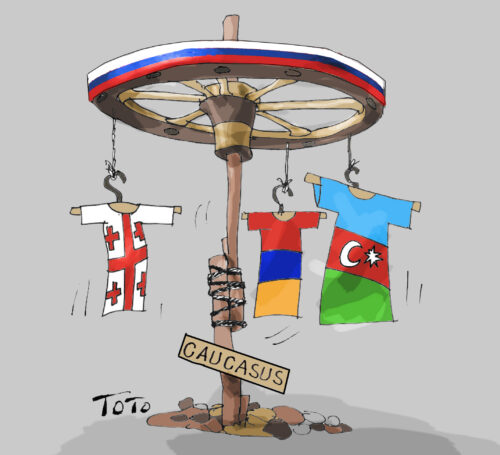
In recent days, the number one topic of discussion in Armenia has been European integration, and therefore there has been no shortage of analyses and debates on the issue. It is not surprising that Russian President Vladimir Putin also addressed the issue in one of his recent interviews. In this interview, he suggested that the Armenian authorities should consider holding a referendum to choose between the Eurasian Economic Union (EAEU) and the European Union (EU). Putin said that he raised this issue more than once in discussions with Armenian Prime Minister Nikol Pashinyan, saying that Russia will support anything that is beneficial to the Armenia. He mentioned what he termed Russia’s special relations with the Armenian people for centuries, and declared that if a particular decision is beneficial for the Armenian people Russia will not be against it.
At first glance, Putin’s statement may seem surprising given the hostility between Russia and the European Union, the strained relationship between them, and Russia’s broader attitude toward EU policies, particularly in what Moscow traditionally considers its sphere of influence. Of course, the statement can also be interpreted as diplomatic language, behind which there may be meanings other than those explicitly expressed by the Russian president. I believe the picture is somewhat complex.
It is important to understand that all the facts, especially the developments of recent weeks, demonstrate that Armenia has no intention of moving toward EU membership, and Moscow is clearly well aware of this. It is already evident that Yerevan does not have the strategic objective of joining the European Union, and this is understood in Moscow, Brussels, Washington, and Yerevan alike. Moreover, Armenia’s potential EU membership would not be particularly welcomed in Moscow, Brussels, Washington, or even parts of Yerevan. Therefore, when making such a statement, the Russian president appears to be fully aware that Armenia has neither such a goal nor such an intention.
During his regular contacts with Pashinyan, Armenia’s broader vision regarding the European Union is almost certainly discussed, and the Russian president is well informed about Armenia’s actual strategic objectives. Consequently, Putin’s remarks should be viewed more as an attempt to publicly reinforce the idea that Armenia itself does not truly seek EU membership and that, if such an intention genuinely existed, the Armenian authorities would inevitably hold a referendum on the issue.
Putin likely understands that the Armenian authorities do not wish to organize such a referendum and is probably confident that even if one were held, it would not necessarily produce the required results, either in terms of voter turnout or the final outcome. Therefore, through his statement, Putin is effectively affirming that if Armenia genuinely wanted to move toward Europe, it would already be taking concrete steps in that direction, including organizing a referendum.
The broader purpose of the statement seems to be to reinforce within public consciousness the notion that Armenia neither truly wants nor realistically can move toward the European Union. At the same time, Putin outlined the reasons why Armenia cannot simply decide to move toward the European Union. The primary reason, of course, is the deep economic relationship between Armenia, Russia, and the Eurasian Economic Union (EAEU), as well as the scale of Armenia–Russia trade turnover. In this context, the numbers are extremely important.
It is clear that EU integration is currently unrealistic for Armenia due to the significant differences between the economic systems, the absence of common borders with the European Union, and the broader limitations of economic integration prospects. If the Armenian–Turkish border was open and either Turkey or Georgia was EU members, it would naturally be much easier for Armenia to move toward EU membership. However, under current conditions, such a scenario appears unlikely.
At the same time, it is important to recognize that the European Union’s bureaucratic and institutional process for accepting new members is highly complex. In this regard, Georgia and Ukraine serve as good examples, as both have spent nearly two decades attempting to move closer toward EU membership but never gained it.
Furthermore, it is difficult to imagine that the EU is currently prepared to create another major point of tension with Russia in the South Caucasus, where peace remains highly fragile. Therefore, all these factors have likely been carefully considered in Moscow, leading to the conclusion that Armenia is unlikely to become an EU member in the foreseeable future. It is precisely on the basis of this assessment that Russia appears to be shaping its current approach.
The Armenian Mirror-Spectator